
В начале августа состоится первое собрание киевского Социалистического Коллектива Пациентов.
У СКП два основных направления работы, первое направление – помощь жертвам репрессивной психиатрии в Украине с либертарных позиций. Работа с наркопотребителями, поддержка программ снижения вреда, декриминализации наркотиков, снятие социальной стигматизации. В этой области мы, безусловно, будем взаимодействовать с правозащитными организациями.
Второе направление – работа с собственными психическими проблемами активистов. Нетрадиционные способы терапии (в частности, Aktionsanalyse, психоделическая терапия). Изучение своих “болезней” и использование их в революционных целях.
СКП-Киев неофициально существует с зимы и, фактически, находится в спячке. Никакой публичной деятельности под этим названием мы ещё не осуществляли. Название группы отсылает к леворадикальному кружку, который был создан в немецкой психиатрической клинике в 60-е годы прогрессивным доктором Вольфгангом Хубером, тем не менее, мы не определяем себя как прямых наследников традиции исторического Sozialistisches Patientenkollektiv.
Предпосылками для участия являются: либертарные политические убеждения, интерес к психиатрии/антипсихиатрии, готовность работать в этом направлении. По поводу участия можно связаться со мной по электронной почте  .
.
Дополнительные материалы:
https://www.facebook.com/
группа интересующихся СКП в фейсбуке (международная)
http://nihilist.li/2014/04/13/
декларация товарищей из московский секции СКП (киевская декларация ещё не написана и она, я полагаю, будет отличаться)
http://nihilist.li/content/
статья об историческом СКП
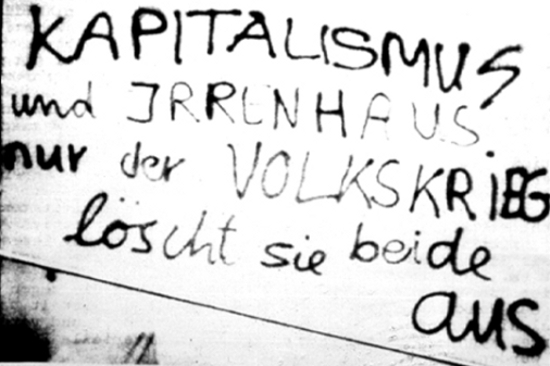
Turn our illness into weapon!
21 комментарий “Социалистический Коллектив Пациентов Киева”
Сколько нужно выкурить травы, чтобы к вам вступить?
вообще не обязательно её курить. я лично даже от алкоголя на пару
месяцев планирую отказаться
Сильные духом…
А что сегодня понимать под репрессивной психиатрией?
Я например четыре раза лечился в психиатрическом стационаре, но
лишь один раз – по постановлению суда. При чем в первых трех
случаях лечение и пребывание в больнице оплачивал я или мои
родственники, а вот в последнем случае – государство. Можно ли
считать это репрессией?
ну, “репрессивный” характер психиатрии определяется не только от
постановлением суда, тут всё ещё зависит от характера лечения. у
Ройзмана люди вот тоже “добровольно” лежат.
Ху из Ройзман?
а загуглите. борец с наркоманией, лечит ломку пиздюлями и
приковыванием к батарее
Фашист. … А вообще-то надо разобраться.
Народный герой и мэр Свердловска.
Да. а что касается репрессивной психиатрии, вот простой пример:
http://shiitman.net/2013/07/16/karatelnaya-psihiatriya-zaporozhe-2013-god/
вообще было бы очень интересно с вами пообщаться, пишите как будете
в Киеве. ну и в лагерь можно подъезжать
Да я слышал о деле Р. Радченко. Под давлением СМИ ее вскоре
опустили. Подобные случаи были в Виннице (профсоюзый активист
Бондаренко) и еще по Украине. Но все это касалось людей, которые до
этого не имели проблем с психикой.
Андрей Здоров Это был сарказм про народного героя. Сто раз с этим
персонажем разбирались, все с ним понятно. Совестливый садист, если
в двух словах. Но он действительно мэр Свердловска.
http://blogs.korrespondent.net/celebrities/blog/mykolakn/a33030 Хто
все ж таки божевільний – суспільство чи Андрій Бондаренко? 24
февраля 2011 | Княжицький Микола Про Андрія Бондаренка мені
розказав керівник Вінницької правозахисної групи Діма Гройсман. Це
була просто детективна історія. За словами Діми, Андрій Бондаренко
абсолютно випадково, працюючи чи то сторожем, чи то охоронцем в
Росії, прочитав колись книжку під назвою “Основи держави і права”.
Прочитав і зрозумів, що все в нас не так влаштовано, як книжка
пише. Повернувся Андрій у Вінницю і влаштувався вантажником на один
з заводів. А крім того, що вантажником влаштувався, ще й створив та
очолив на цій фірмі профспілку. Кому з керівників таке
сподобається? І його звільнили. Але власники фірми, на якій
працював Бондаренко, не знали, що за нашим законодавством для того,
щоб очолювати профспілку підприємства зовсім не обов”язково на
ньому працювати. І Андрій Бондаренко продовжив власну бурну
діяльність. На Вінничині багато цукрових заводів, де використовують
сезонну працю. Заводи ці часто оформляють у власність на підставних
осіб, банкротять, перереєстровують, а сезонним робітникам не
виплачують заробітню плату. От і почав Андрій виступати в судах від
імені цих ображених робітників. А заодно – почав боротися з
місцевою прокуратурою і судами. Прийшов якось Бондаренко в суд
представляти інтереси чергового ображеного робітника. “Сідай,
синку,” – сказав йому суддя після виступу. Бондаренко відразу ж
впізнав в судді свого батька. Ну не може ж суддя у судовому
засіданні говорити неправду. Тому і звернувся Андрій до іншого суду
з вимогою визнати батьківство новоявленого родича. Скільки таке
можна терпіти? От і вирішила прокуратура визнати Бондаренка
божевільним та відправити на примусове лікування. Поки що не
вийшло. Андрій Бондаренко сам сьогодні ввечері розкаже про це о
21:00 на “ТВі” у програмі “Вечір з Миколою Княжицьким”. Буде ще
багато цікавого. Copyright © 2000-2011, ООО “КП-ТВ”. Все права
защищены.
про Бондаренко тоже каноничный пример, да
http://blogs.pravda.com.ua/authors/kuzyo/4e53acee01a71/ Тарас Кузьо
Доктор, професор, старший науковий співробітник кафедри
українoзнавства в Університеті Торонто Репресивна психіатрія з
політичною метою повернулася до України 23 серпня 2011, 16:36
Версія для друкуКоментарі2 Andrei Bondarenko
http://www.jamestown.org/single/?no_cache=1&tx_ttnews%5Btt_news%5D=38335
Psychiatric Abuse For Political Purposes Returns to Ukraine
Publication: Eurasia Daily Monitor Volume: 8 Issue: 159 August 17,
2011 04:47 PM Age: 6 days By: Taras Kuzio The Soviet abuse of
psychiatry for political purposes isolated thousands of political
and religious prisoners in psychiatric hospitals. Some of these
practices continued in post-Soviet countries such as Russia and
Uzbekistan, but have only been reported in Ukraine since 2010 – the
year in which Viktor Yanukovych was elected president. In June
2010, only five months after Yanukovych was elected, the Ministry
of Interior (MVS) Human Rights Monitoring Department, established
in 2008 with a mandate to hold the police accountable for its
actions, was closed. Two months later the MVS disbanded its hate
crimes investigations unit. The headline “The Gangster Era Has
Already Returned” summed up the prevalent view that law enforcement
officers are no longer even partially accountable for their actions
(Komentari, July 22). Uzbekistan has taken the lead in the former
Soviet Union in sentencing oppositionists for speaking out. In
2005, following the actions by the security forces in Andijan,
Holly Carter, Europe and Central Asia Director at Human Rights
Watch, said “This is an insidious attempt to equate criticism of
the government with insanity” (www.hrw.org). Psychiatric abuse for
political purposes in the USSR was brought to the attention of the
democratic world in 1971, when the Russian dissident Vladimir
Bukovsky smuggled into the West a 150-page file documenting
political abuse of psychiatry. The documents were discussed in The
Times as well as the British Journal of Psychiatry and became an
ongoing subject of rancorous debate in the World Psychiatric
Association (WPA) over the next two decades. At the WPA Mexico
Congress in November 1971 the Soviet delegation walked out. The
following four cases constitute the first Western analysis of the
return of psychiatric abuse for political purposes in Ukraine. The
first is that of Andrei Fedosov, the Chairman of an NGO in the
Crimea that defends the rights of disabled people
(www.amnesty.org). In an October 2010 press release the
international human rights organization, Amnesty International,
described Fedosov’s work as including the monitoring of psychiatric
hospitals. This research detailed allegations of unlawful
confinement in psychiatric institutions, as well as torture and
ill-treatment of patients in three such institutions
(www.amnesty.org, October 2010). Fedosov was assaulted by unknown
thugs in May 2010 and two months later detained for a crime he
allegedly committed a decade ago when he was 15 years old. He fears
for his safety and possible trumped up charges. The second case is
that of Andrei Bondarenko who in October 2010 was ordered to
undergo a forced psychiatric examination by a court in Vynntsia.
Bondarenko had earlier undertaken three psychiatric examinations to
prove his sanity. Echoing the Soviet and Uzbek cases above, the
official Ukrainian justification for the attempt to incarcerate
Bondarenko in a psychiatric hospital is his “excessive awareness of
his own and others’ rights and his uncontrollable readiness to
defend these rights in unrealistic ways” (www.amnesty.org, November
3, 2010). Heather McGill, Amnesty International’s expert on
Ukraine, said “There is a very real concern that Andrei Bondarenko
will be subjected to a forced psychiatric examination because of
his legitimate trade union and human rights activities”
(www.amnesty.org, November 4, 2010). Bondarenko has been an
independent trade union activist since 2006 and in 2009 he was
elected deputy head of the local branch of the independent trade
union “Laborers” (Trudiashchi). His campaigns have threatened the
vested interests of local businessmen and officials, particularly
in the sugar industry. A third case is that of Rostyslav Chapran,
arrested by the police in April on trumped-up charges demanding
that his family must pay a ransom of 3,000 Euros ($4,322) to have
him released. As in other similar cases, Chapran was first given a
15 day sentence under the catch-all charge of “hooliganism” and
upon its completion he was charged with an attempted murder
allegedly committed in 1999 (http://helsinki.org.ua, June 1).
Chapran’s original detention was in violation of article 5 of the
European Convention of Human Rights. The purpose of the article is
to ensure that the police can produce evidence for the charge,
which, as Amnesty International points out, is often obtained in
Ukraine through torture or other ill-treatment (www.amnesty.org,
June 16). On April 22, Chapran was transferred to a psychiatric
hospital where he was incarcerated until May 26. During his
incarceration he was held incommunicado with his family not knowing
where was he was being detained. As Amnesty International
highlighted in an “Urgent Action” press release, “It is normal
practice in Ukraine for suspects accused of serious crimes to be
sent for psychiatric evaluation as an inpatient in a closed ward of
a psychiatric hospital…” (www.amnesty.org, June 16). A fourth
case is that of Kostiantyn Lavrov, head of the Civic Force NGO who
was ordered to undergo a psychiatric examination in Donetsk after
organizing public protests against construction by the MAKO
Company, whose president is Oleksandr Yanukovych, a Party of
Regions deputy and the eldest son of President Yanukovych. On May
15, MAKO began demolishing the Soviet era Hotel Druzhba to replace
it with an apartment complex. Local residents appealed to the
courts to annul the April 15 decision by the Donetsk city council
to transfer the land under Hotel Druzhba for 49 years to MAKO
(Ukrayinska Pravda, July 14, Ostrov, June 21). On June 9, local
thugs in typical sports attire who presumably had been hired by
MAKO physically attacked the protestors (Ukrayinska Pravda, June
21). On June 20, Lavrov was arrested on trumped-up charges of
demanding a bribe of $7,000 from MAKO to halt the protests and nine
days later he was ordered to undergo a psychiatric examination. His
lawyer responded: “I believe there is no basis whatsoever for such
a court decision” (Ukrayinska Pravda, July 14). The use of false
charges to incriminate civil society activists is growing. Two
environmental activists arrested in Kharkiv, who organized protests
against tree felling, are considered by Amnesty International to be
“prisoners of conscience” (www.amnesty.org, June 18). As in the
above and other cases, thugs in sports outfits attacked the
protestors while the police looked on. Criminal charges against
nine leaders of the anti-tax code protests for “damaging” floor
tiles on Independence Square after erecting tents are another
example of trumped-up charges (http://helsinki.org.ua, January 18).
In the spring of 2007, Party of Regions activists put up similar
tents on the square in protest against President Viktor
Yushchenko’s decree dissolving parliament. Intimidation of civil
society activists is a deliberate tactic to subdue Ukrainian
society and forestall potential protests or a second Orange
Revolution. These tactics, reminiscent of other authoritarian
regimes in Eurasia, are inconsistent with European values that
Ukrainian officials repeatedly claim allegiance to. A return to
political abuse of psychiatry is certainly more reminiscent of the
Soviet Union than the EU.
Была еще классная статья Ильи Романова http://zavolu.info/2614.html
04-06-2010 Психиатрическая голограмма Илья Романов
Треба прийти подивитися. Олександре, а засновники того СКП,
здається, здеградували до зовсім якихось ультраправих маргиналів,
ні?
У нас в Павловке работает Глузман, он не тянет?
Семен Глузман – человек интересный и диссидент со стажем, но
последние десять лет все больше становится публичным политиком.
А справа Gustl Mollath — це реально каральна психіатрія в Європі,
чи «прикра помилка»?